
The short version, if you’re skimming:
- We said we’d have 500 members by September. We have 51. We’ve been building, not marketing — that needs to change, and this post is a start.
- What we have built is genuinely exciting: six working app prototypes, a fully functional PWA onboarding flow, and real progress on the backend infrastructure that will power PLANET.
- The funding picture has shifted. We’re still hopeful that First Person Cooperative investment will arrive — but we can’t build on that assumption alone.
- We’re exploring a new direction: a community platform proposition that would let us generate revenue, develop the tools, and use The Open Co-op itself as our first testing ground.
- We already have a few networks in our sights as potential early adopters — and we’d love introductions to others.
- We need your input, your contacts, and — if you have the right skills and appetite — potentially you.
Who we are and what we’re building
The Open Co-op is a member-owned cooperative building PLANET — a Personal Network Manager that gives people and communities genuine ownership of their digital lives. PLANET is built on the First Person Project’s open protocol stack: decentralised identity, verifiable credentials, and trust infrastructure that puts users, not platforms, in control.
If you’re already a member, you know this. If you’ve landed here from somewhere else — welcome. This post is an update for our community, but we’re publishing it openly because we believe in doing this work in public.
Where we are, honestly
When we set out in March, we wrote an ambitious strategic plan with three priorities: People, Prototype, Planning and a six-month timeline. By September, the goals included 500 members, 30 active contributors, and working demos of PLANET’s core apps.
We’re now at 51 members, which is way short of the plan.
What happened? We made a choice, probably the right one, though it came at a cost. Rather than spending the first few months marketing membership, we’ve focused on building. We want to have something real to show before asking people to rally around it.
What we’ve built
Since March, we’ve produced six interactive app prototypes covering the core PLANET experience. These aren’t mockups or wireframes, they’re coded, interactive demos, which we’ve iterated on to include feedback from members, that give you a real sense of how the apps might function.
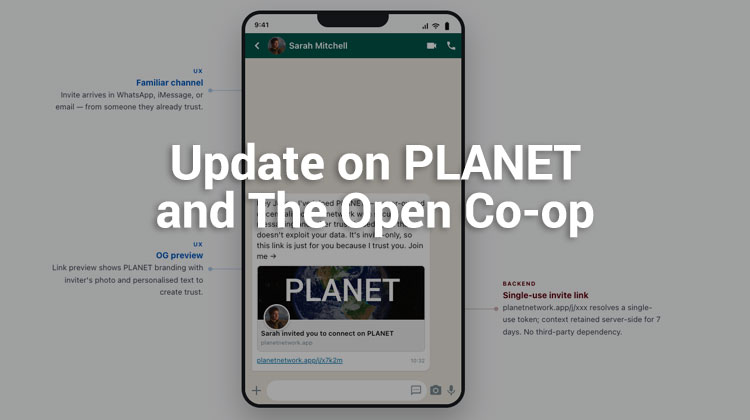
- PWA Onboarding — An invite-only, install-as-PWA onboarding journey. You receive an invite, add PLANET to your home screen, and arrive straight into a chat with the person who invited you. Keys are generated silently in the background; a recovery phrase secures your account.
- Invite Flow — How an existing PLANET user brings someone new into their trust network: pick a recipient, hand off to the OS share sheet, watch the contact move from pending to connected once they join. One careful invite at a time.
- Blog (First Person Pages) — Jonny installs the blog app, writes a post, signs it with his DID, and publishes. A visitor reads it, a PLANET member follows and comments, Jonny replies. Write it, sign it, read it, talk back.
- Feeds — Maya installs the Feeds app and configures her Home feed: content mix, trust profiles, who she follows with per-follow hashtags. Jonny’s regenerative post lands in her feed because she followed him for #regenerative in the Blog demo. Build your own algorithm.
- Main Personal Network Manager — The core app: chat reactions, group chats, an encrypted vault, app store, and alerts.
- Introducer — A PLANET app that facilitates trusted introductions between people. Follow an introduction from compose to completion: consent, group chat, a graceful bow-out, marking value, watching ripple effects through the network.
In total: six apps, forty-five screens, a coherent and illustrative demo of the PLANET experience.
On the backend: the First Person Project team have also launched firstperson.dev a developer-facing environment where you can demo and test setting up a Verifiable Trust Agent (VTA) and joining a Verifiable Trust Community (VTC). It’s not for end users, but it proves the underlying infrastructure is being actively built and is working. Progress there has been rapid, and it gives us real foundations to build on.
The funding picture
We’ve always been open about the fact that PLANET’s full development depends on investment, whether from the First Person Cooperative, grants, or other sources. The FPC are continuing to pitch for funding, and if they’re successful, they may be able to support our work to develop PLANET into a fully functional Personal Network Manager (PNM – an app to manage your trust networks) with the plumbing to connect it to the backend infrastructure.
But we’ve also had to be honest with ourselves: that funding may not arrive on our timeline. We can’t build a plan that depends entirely on a single outcome we don’t control. So we’ve been thinking about what a parallel path looks like.
A new direction we’re exploring
Here’s where we’d love your input.
One thing we’ve noticed, partly from building PLANET, partly from the backend work on the First Person Project, is that the core infrastructure has a more immediate application than a full Personal Network Manager like PLANET. The tools for verified membership, trusted communication, community governance, and private knowledge management are things that communities need right now, and the tools they’re currently using (spreadsheets, Facebook Groups, Mailchimp, Google Forms, WhatsApp) are clearly not good enough and are leaching data to the corporate overloads.
We’re exploring whether we can build a community platform — working title: Community OS — that brings together five things communities currently cobble together from multiple extractive platforms:
- Members — verified membership management, replacing spreadsheets and clunky members areas
- Communicate — announcements to verified members only, replacing Mailchimp
- Discuss — gated, community-owned forums and chat, replacing Facebook Groups and WhatsApp
- Decide — verifiable one-member-one-vote governance, replacing Google Forms and AGM proxies
- Know — a private AI assistant trained on the community’s own knowledge, replacing leaky corporate AI tools
The verifiable trust infrastructure, the VTAs, DIDs, and credential layer from the First Person Project, would run invisibly underneath these tools. What communities would see is a clean, integrated platform they actually own.
The Open Co-op would be our first testing ground. We’d build it, use it ourselves, learn from it in public, and use that experience to develop it for others.
We’re at an early stage with this thinking. We’re not announcing a product launch. We’re sharing a direction and asking: does this resonate? Does it solve a real problem you’ve seen in communities you’re part of or connected to?
Early interest — and a request for introductions
We’re already in early conversation with a small number of networks who’ve expressed interest in being among the first to test something like this.
If you know a community, professional network, cooperative, or membership organisation that struggles with the kinds of tools problems we’ve described above, and you think they might be open to hearing about what we could offer, we’d genuinely love an introduction. These contacts would be really valuable to us right now, and a warm introduction from a trusted member is worth more than any cold outreach we could do.
What we’re asking from you
Three things, in order of effort:
1. Tell us what you think. Does the direction above make sense to you? Does it feel like the right move, a distraction, or something you’d want to help shape? Reply to the email that brought you here, or join The Open Co-op and reply via our Signal group. This is an open question – nothing is set in stone.
2. Make introductions. If you know a network manager, community organiser, or membership organisation that might benefit from Community OS, put us in touch. Even a “you should speak to X” message would really help.
3. Get involved. If you have skills or experience in any of the following areas, we’d love to talk about whether there’s a role for you in what we’re building:
- Product design and UX (particularly for SaaS or membership platforms)
- B2B SaaS development or go-to-market experience
- Community building and network management
- Impact investment or cooperative funding
We’re not advertising jobs. We’re looking for people who want to help shape this from the ground up.
One more thing: come and join us
We’re at 51 members. We’d like to be at 500. If you’re reading this and you’re not yet a member of The Open Co-op, you can join at collab.open.coop. Membership is free (although a monthly contribution would really help), and it’s how you stay part of this conversation as it develops.
And if you know someone who should be part of the collaboration, please send them this post.