
For over twenty years, at The Open Co-op, we’ve been working towards a vision of a cooperative, regenerative economy — one that is owned and governed by its participants, and designed to serve people and planet over profit.
That vision has always depended on something the internet lacked – a way to know who and what you can trust. But now, for the first time, the foundations for a trust-based internet are starting to emerge. So, we’re relaunching The Open Co-op in preparation, to be ready to leverage this new trust-based infrastructure and deploy our major project: PLANET — a member-owned co-operating system to support collaboration at scale.
Who Can You Trust?
Trust, it turns out, is in short supply in pretty much every sector of society: Only 15% of people trust social media (OECD 2023), only 22% of people trust governments (Pew 2024), only 27% of people trust banks (Gallup 2023), and only 32% of people trust news media (OECD 2023) – this is a sorry state of affairs!
But the infrastructure to support a more trust-based society, and the PLANET vision, is under active development via the First Person Project, who are working in collaboration with the Linux Foundation Decentralized Trust project and a global consortium of other projects.
To understand the significance of The First Person initiative, it helps to understand who else is paying attention to the project.
At the heart of much of the world’s digital infrastructure (phones, laptops, cars and even washing machines – basically any device with a processor inside) is the Linux kernel — the core software that underpins vast parts of the internet. The people who maintain it, the Linux kernel maintainers, are responsible for reviewing and approving changes to this critical codebase. Their job is to protect the integrity and security of a system that billions of people indirectly rely on every day.
In 2024, that trust was tested.
In what is now known as the XZ Utils backdoor, a highly sophisticated and long-running attack saw a malicious actor gradually build credibility within the XZ Utils project (a standard utility in most Linux distributions), eventually gaining enough trust to introduce a backdoor into the software. The implications were enormous: it exposed how vulnerable even the most respected and security-conscious ecosystems can be when trust and identity are not verifiable.
This is the problem the First Person Project’s trust infrastructure aims to solve.
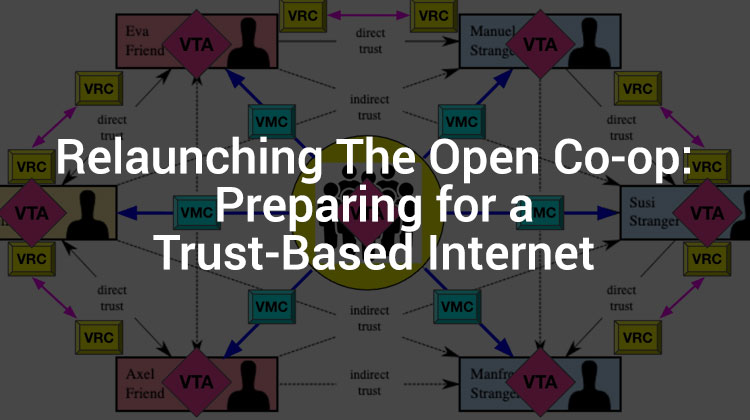
By enabling verifiable identity, cryptographic proof of authorship, and transparent trust relationships, it becomes possible to know not just what code is being contributed, but who is behind it, how they are trusted, and how that trust was established.
And crucially, the Linux kernel community is exploring the First Person approach to strengthen its own security, which is a profound signal for the project.
If the system is robust enough for one of the most security-critical and technically demanding communities in the world, then it has the potential to underpin far more than software development. It suggests we are looking at infrastructure that could support trust across the entire internet.
What This Means for The Open Co-op
While the First Person Project and its partners focus on designing and building the protocols and plumbing to support this trust-based infrastructure, The Open Co-op is focused on what it enables.
We are exploring how this new layer of trust can be used in everyday life — in co-operatives, local communities, regenerative projects, and global collaboration networks. If everything goes well, we will finally be able to deploy the tools to support a global trust-based, collaborative network.
We are working on this vision via our PLANET project, which we describe as ‘a cooperating system for the collaborative regenerative economy’. Because, if this trust-based infrastructure is to fulfil its potential, it must be understandable, accessible, and genuinely useful to ordinary people. It must help groups form, collaborate, make decisions, share resources, coordinate action, and provide viable alternatives to the tools we rely on from today’s extractive platforms.
That is what we are building towards with PLANET.
Why This Changes Everything
The Internet was never meant to be privately owned. But for decades, big tech platforms have been controlling identity, reputation, and relationships and turning users data into revenue. We have inadvertently outsourced trust to the big tech giants who have manipulated our online experiences for profit.
What is emerging now is something fundamentally different: An internet where identity and trust based relationships can be owned by individuals and communities. Where reputation travels with you. Where cooperation can scale without central control.
The implications go far beyond technology projects.
For co-operatives, it means new ways to coordinate with members and govern without the use of surveillance technologies. For local community projects, it means being able to surface, strengthen and leverage vast networks of pre-existing trust relationships. For low carbon, behaviour change and transition initiatives, it means access to tools that are designed for democratic collaboration, coordination and decision-making at scale, rather than systems that are designed to extract value from every user.
Over time, and with your help, PLANET aims to provide all of the above – as an open source co-operating system for the regenerative economy that is owned and governed by its members as a commons.
Why We Are Relaunching Now
The underlying trust infrastructure is not yet fully ready. But it is real, advancing quickly, and being tested by some of the world’s leading software developers.
Our role is to be ready to build on it as soon as it’s available.
That means designing the experiences, tools, and organisational models that will enable us to leverage this infrastructure for cooperative and regenerative purposes from day one. It means prototyping, testing, and refining how people and communities will actually interact within trust networks. It means building the social layer alongside the technical one.
In short, we are preparing to leverage this breakthrough for the commons.
Help Shape What Comes Next
This is an open invitation.
We are looking for people who want to help shape the user experience, the tools, and the structures of a trust-based economy. Designers, developers, co-operators, community organisers, and anyone interested in building a better system.
This is not about another platform. It is about seeding the infrastructure of a new economy — one that is cooperative by design, regenerative in purpose, and owned by the people who use it.
This work is happening in the open, and we invite you to get involved and collaborate with us to shape how these ideas translate into real tools and systems to support the regenerative economy.
Everyone is welcome. Please join us.